Sunday, September 20, 2009


"PROTOCOL (original version):
- for each closed polygons
- for each faces
- extract edges
- add polylines: array(edge start pt, end pt,face centroide)
- offset the curve (on face - toward the centroide)
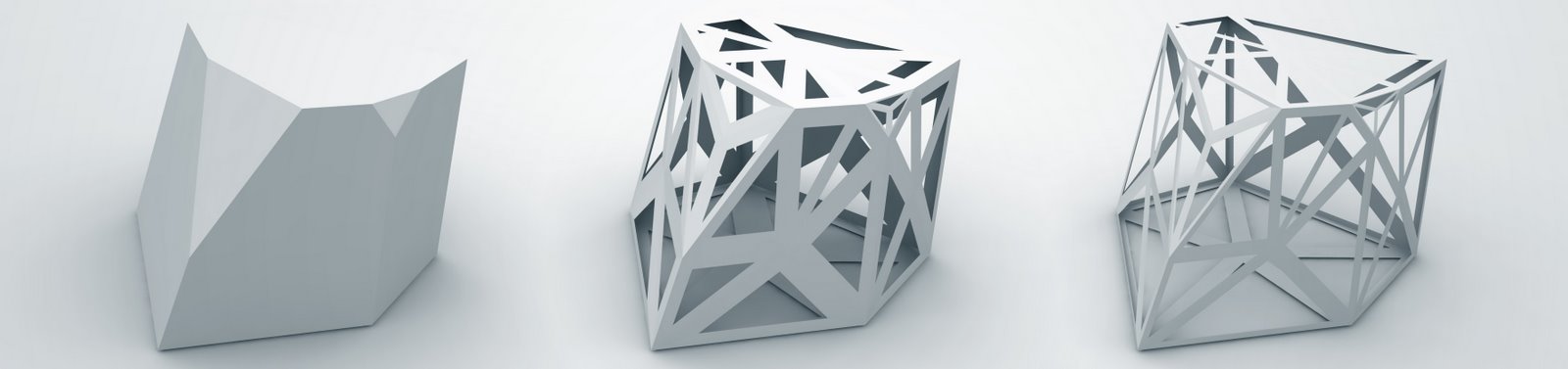

Many "quick fix" upgrades are possible:
recursive subdivision according to face aera, membrure thickness according to edge length, etc...

select points within closed polygones, points relaxation/explosion, frame along the edge of polygons, etc..."

- http://www.theverymany.net/labels/structure.html

Seems to be a certain likeness to these renders and my proposed sort of structure wind turbine. Need to get onto Rhino and see if these commands are relevant. May need to go back and look at previous tut where we recreated the 'gherkin'

Key Word - 'Structure'


Structure is a fundamental and sometimes intangible notion covering the recognition, observation, nature, and stability of patterns and relationships of entities. From a child's verbal description of a snowflake, to the detailed scientific analysis of the properties of magnetic fields, the concept of structure is an essential foundation of nearly every mode of inquiry and discovery in science, philosophy, and art.[1]

A structure defines what a system is made of. It is a configuration of items. It is a collection of inter-related components or services. The structure may be a hierarchy (a cascade of one-to-many relationships) or a network featuring many-to-many relationships.

In biology, structures exist at all levels of organization, ranging hierarchically from the atomic and molecular to the cellular, tissue, organ, organismic, population and ecosystem level. Usually, a higher-level structure is composed of multiple copies of a lower-level structure. (http://en.wikipedia.org/wiki/Structure, Pullan, Wendy (2000). Structure. Cambridge: Cambridge University Press. ISBN 0521782589.


more theo Jansen


Kinetic Sculptor – Theo Jansen April 7, 2009


"Theo Jansen is part artist, part engineer. He builds moving sculptures using complex algorithms and lightweight materials – the wind does the rest."

Theo Jansens Strandbeests

Need to find these algorithms or details of the structural componants. His work is unbelievable. Check out his movie below. I especially like the clad versions of his strand beasts.

http://www.cove.org/ape/demo2.htm -
is a great site for modeling the physics behind the structures. It is called the Actionscript Physics Engine or APE. Querying the availability of this program to produce my own prototype.

Saturday, September 19, 2009

additional elements


URBAN SCREENS investigates how the currently commercial use of outdoor screens can be broadened with cultural content. We address cultural fields as digital media culture, urbanism, architecture and art. We want to network and sensitise all engaged parties for the possibilities of using the digital infrastructure for contributing to a lively urban society, binding the screens more to the communal context of the space and therefore creating local identity and engagement. The integration of the current information technologies support the development of a new integrated digital layer of the city in a complex merge of material and immaterial space that redefine the function of this growing infrastructure.
URBAN SCREENS defined as various kinds of dynamic digital displays and interfaces in urban space such as LED signs, plasma screens, projection boards, information terminals but also intelligent architectural surfaces being used in consideration of a well ballanced, sustainable urban society - Screens that support the idea of public space as space for creation and exchange of culture, strengthening a local economy and the formation of public sphere. Its digital nature makes these screening platforms an experimental visualisation zone on the threshold of virtual and urban public space. (Mirjam Struppek) - http://www.culturebase.org/home/urbanscreens/

Possibility of adding some further dimensions to the structure. Depending on the surface of the element the 'thing could be used to displsy art/information screenings. Could be quite interesting given the rotating nature of thepiece. This surface may be made as relatively flat and stable given the high rotating capabilities of the wind turbine. (may blur into one solid form. Much like the large installlation of the sony ad that shows how the motion flow on the TV works. This thinking is actually very old as it has been used in theory with pin hole cameras.

"Motionflow 200Hz is the world’s first quadruple speed 200Hz frame rate conversion that helps to improve the clarity of fast-moving objects on screen. It creates three new intermediate images based on the incoming signal and inserts them between the original pictures and thus images are displayed at a rate of 200 fps. As a result, Motionflow 200Hz offers sharp and smooth reproduction of fast-moving images especially when you’re watching sports programmes. " - http://www.sony.com.au/product/kdl-52z5500#Motionflow™%20200Hz


"Simply stated, a wind turbine works the opposite of a fan. Instead of using electricity to make wind, a turbine uses wind to make electricity.
The wind turns the blades, which spin a shaft, which connects to a generator and makes electricity The electricity is sent through transmission and distribution lines to a substation, then on to homes, business and schools." - http://energiaeoliana.wordpress.com/2008/03/13/how-a-wind-turbine-works/

Project similarities


An example of a proposal that is, I think relevant to the assignment, one page of explanatory information using the computer. It also deals with wind and the effects of wind on structures.

Smaller example of wind catching unit being made at the moment.


"Windation Energy Systems, a Menlo Park, Calif.-based start-up, has developed a wind appliance that looks more or less like the modern heating and cooling equipment you see on flat corporate building rooftops.
There's an 8-by-8-foot frame around a 10-foot-high cylinder. Wind blows in the top and is directed to the bottom where the wind turns a turbine to make up to 5 kilowatts of electricity. A single unit wouldn't generate enough power for an entire office building but could offset a significant portion, the company says."
- http://asia.cnet.com/crave/2008/10/13/urban-wind-power-inspired-by-ancient-persia/


Smaller less aesthetically pleasing example of a wind catcher/energy generator.

Other wind examples.


Other examples of structures that use the wind for certain purposes whether for supersticious or practical reasons.

Wind catcher in homes and Iranian windmill


1. Wind catcher, for summer ventilation


and common wind catching techniques used in Iranian architecture


"Why put a fan to catch the wind at ground level, where the wind speed is lowest, rather than 3 metres or more in the air? The extra speed of the wind would soon repay the work of putting-up the supporting structure. Why mount a heavy millstone and its supply of grain on a supporting structure, when it could rest on the ground beneath?As it happens, although the sources assumed that such a primitive device no longer exists Iranians continue to catch the wind to cool their houses through ingenious structures on top of their houses that can be traced back almost 2000 years. One can easily imagine such a structure adapted for a simple wind-driven mill." - Image 1 and 2 and passage from http://www.ullesthorpewindmill.org.uk/index.php?act=viewDoc&docId=7

Structural merits of tumbleweed.


The structural merits of the tumbleweed are to be taken into consideration. The fact that they are designed to be as light as possible yet surrender as much surface area to the wind is to influence the composition of the wind catcher. The mesh like qualities also lend itself to certain structural joins and movement that could influence certain rotations in the designing of the proposed wind catcher.

Friday, September 18, 2009

quiet revolution


egg beater wind turbines


"Eggbeater" turbines. They have good efficiency, but produce large torque ripple and cyclic stress on the tower, which contributes to poor reliability. Also, they generally require some external power source, or an additional Savonius rotor, to start turning, because the starting torque is very low. The torque ripple is reduced by using three or more blades which results in a higher solidity for the rotor. Solidity is measured by blade area over the rotor area. Newer Darrieus type turbines are not held up by guy-wires but have an external superstructure connected to the top bearing.

wind turbine


A wind turbine is a rotating machine which converts the kinetic energy in wind into mechanical energy. If the mechanical energy is used directly by machinery, such as a pump or grinding stones, the machine is usually called a windmill. If the mechanical energy is then converted to electricity, the machine is called a wind generator, wind turbine, wind power unit (WPU), wind energy converter (WEC), or aerogenerator.

Bluenergy Solar-Wind-Turbine


Bluenergy Solar-Wind-Turbine

"BSWT is a vertical wind turbine based on sailing engineering. The wind rotor is rotated by two spiral-formed vanes. For best performance, these vanes are covered in solar cells, so that sun and wind produce electricity as one element. The BSWT installation costs relatively little, produces no noise or significant shadowing, can be easily maintained from ground level, and is an attractive addition to any home." - http://www.bluenergy-ag.net/English/products_wind.html

Wind Dam


The massive growth in 2008 swelled the nation’s total wind power generating capacity by 50% and channeled an investment of some $17 billion into the economy, positioning wind power as one of the leading sources of new power generation in the country today along with natural gas, AWEA added. However, at year’s end financing for new projects and orders for turbine components slowed to a trickle as layoffs began to hit the wind turbine manufacturing sector.
“Our numbers are both exciting and sobering,” said AWEA CEO Denise Bode. “The U.S. wind energy industry’s performance in 2008 confirms that wind is an economic and job creation dynamo, ready to deliver on the President’s call to double renewable energy production in three years US - Wind Energy Generating Capacity Grows by 50%
in 2008
»
wind-energy1
Posted on January 28, 2009
1 Comment »

The Java Virtual Wind Tunnel

A Two Dimensional Computational Fluid Dynamics SimulationThe Java Virtual Wind Tunnel is an applet which uses computational fluid dynamics (CFD) methods to simulate the flow of air over a two dimensional object. The applet is not just a movie projector; it actually solves the equations of motion (the Euler equations) in real time. So the results on the screen are the real thing, not an animation. And in a virtual wind tunnel, adding instruments costs nothing. In fact, the simulation provides more information about the flow than you could easily access in any real wind tunnel.
The Java Virtual Wind Tunnel is just a prototype. But it shows how Java can be used to build
educational tools for undergraduate and graduate fluids mechanics courses. At the undergraduate level, the simulations might help students visualize and understand 2-D fluid flow. At the graduate level, it might help students understand the power and limitations of computational fluid dynamics.
The prototype Java Virtual Wind Tunnel is running at the top of this page. This demonstration shows the flow of air through a channel with a "bump" in one of the walls. If you let the applet run, a shock wave will appear above the bump where the flow jumps from supersonic to subsonic speeds. Moving the sliders will change the flow conditions and cause the shock to appear and disappear. -
http://raphael.mit.edu/Java/ - David Oh / Computational Aerospace Sciences Laboratory, MIT / bamf@attbi.com

Thursday, September 17, 2009


Wind power is a small contributor of energy in Australia – as of 2008, approximately 1% of Australia's electricity is sourced from wind power,[1] the majority of which (60%) is produced by South Australia's nine operating wind farms. The rest can be found in Victoria (five), Western Australia (five), and NSW (four). Construction of several wind farms is underway, and several projects were approved in 2008 and are set to be built in Victoria and South Australia. Due to government legislation and private investment, wind power generation is exponentially increasing and in the coming years will continue to grow; by 2020, more than 20% of Australia's energy could be sourced from wind power. - http://en.wikipedia.org/wiki/Wind_power_in_Australia


The broad context of nature and architecture and computing calls for me to pinpoint a topic and work on that from now on. I attempt to use the structures in nature to create a moving functional structure that proposes an alternative to wind turbines and offer an aesthetic componant to this structure. This image reflects this line of thinking, coupled with the video showing theo Jansen's structural art below.

Tuesday, September 15, 2009


Tutorial 8


Tutorial 8.